Previous - Trumpets
Revelation 8
The First Four Trumpets
The Seventh Seal
At the beginning of Revelation 8, we are back in the chronology of the book. This can be seen in the verb tense – past tense: ‘and when the Lamb opened the seventh seal, there came…’
If we line up the sentences about the opening of the seals, we get the following:
(1) ‘And I saw when the Lamb opened one of the seven seals, and I heard…’
(2) ‘And when the Lamb opened the second seal, there heard…’
(3) ‘And when the Lamb opened the third seal, there heard…’
(4) ‘And when the Lamb opened the fourth seal, there heard…’
(5) ‘And when the Lamb opened the fifth seal, there saw…’
(6) ‘And I saw when the Lamb opened the sixth seal, and there came…’
(7) ‘And when the Lamb opened the seventh seal…’
We see two seals with a different syntax, seals (1) and (6). With this, the Word indicates that a new phase of history is entering. With the first seal, this is self-evident. The Lamb begins by opening his title deed and the plan to carry it out. The first seal results in the white horse, the heavenly intervention on behalf of God's people, who—given other scriptures—are oppressed and are led by God to total victory over all enemies. The white horse concerns the Palestinian people, the true descendants of Israel's 12 tribes, who, after many decades of the most terrible persecution imaginable, are being restored to their relationship with God. That a new phase of history begins with the sixth seal has already been extensively substantiated in the context of Revelation 6. In summary: under seals 2-4, we see in the horses the human powers and all they have to offer, in subjecting the earth to totalitarian control. The elite of the planet raise their fists toward heaven. However, because they cannot touch God himself, they extend their destructive influence to those on earth who bear God's image: people. From heaven, God is imposing restrictions on the destructive activities of the demon-controlled powers. We are most likely witnessing the beginning of this now.
Seal 6 opens a completely new phase in history. The Lamb has made great progress in opening the document, and its first manifestations are palpable on earth. The horrific scenes on earth have taken on such dramatic proportions that an awe-inspiring reaction erupts from heaven. The first great earthquake with global consequences evokes signs from heaven on the sun, moon, and stars, and finally the earthly rulers realize with whom they are dealing. They hide and, in their fear, cry out to the mountains and rocks to hide them from "the face of Him who sits on the throne and from the wrath of the Lamb."
The earthquake and what follows from heaven have a devastating effect on the earth's infrastructure. In their own words: those in power have been thrown back "to the Stone Age" (hence the mountains and rocks in which they hide), as they themselves have so often done with nations and peoples they sought to control. All wars since time immemorial have been financed and initiated by big money – ordinary citizens don't want war, but they are incited to do so by their governments, usually with the most blatant lies imaginable to conjure up the right enemy image.
With the sixth seal, the rulers themselves are finally caught. This gives the witnesses of God and his Word some breathing room. They can flee en masse into nature. That's why we read in Revelation 7, first of all, that no wind should blow, not on the earth, not on the sea, not on any tree. The one hundred and forty-four thousand Israelites, through whom God's message of the coming kingdom will be proclaimed worldwide, are sealed, and the glorious consequences of their proclamation a few years later are immediately revealed: an innumerable multitude from all nations, peoples, kindreds, and languages enter the glorious kingdom of peace under the protection of "Him who sits on the throne" and under the rule of "the Lamb." They are in the hands of the Father and the Son. Who can ever harm them?
From Revelation 8 onward, we are "back in time" again, and the Lamb continues to open the seals. The seventh seal is actually nothing special, because the initiative for action had already been transferred from earth to heaven with the sixth seal, and until the end of "this present evil age," the initiative will remain in heaven—until all demons, especially the devil, have been completely eliminated and imprisoned. However, what follows the opening of the seventh seal is particularly intense. The most terrible judgments are about to descend from heaven upon earth.
For this reason, "there was silence in heaven for about half an hour." That's considerably longer than the two minutes of silence that are observed in remembrance of the dead in WWII. And silence is very impressive when there is normally a great deal of activity. And that is the case in heaven. In Revelation 4, we read of "lightnings, voices, and thunders" emanating from the throne, and of four living creatures who restlessly, day and night, say, "Holy, holy, holy, Lord God Almighty, who was and is and is to come." And we haven't even mentioned all the activity of angels. For half an hour, everything is silent. Heaven holds its breath for earth, anticipating what is yet to come. God holds his breath too. Judging is something He doesn't enjoy. It is a "strange" task for Him. He is Creator. He is constructive. He is a God who wants to bless, but because of human behavior, the time for punishment has come. Severe punishments. He must engage in destructive activities.
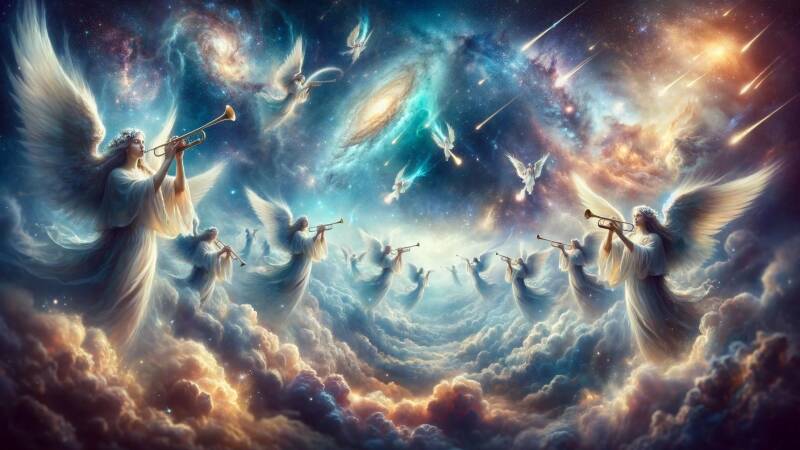
Then comes the sounding of the seven trumpets, which must be blown, and upon which the severe judgments will follow. They are distributed to the seven angels who "stand before God." These are not just any angels. No, they are high-ranking angels, comparable to Gabriel, who announced the birth of Jesus and who said to Zechariah, at the announcement of John the Baptist's birth, "I am Gabriel, who stand before God." (Incidentally, angels are never said to sit before God. That is said only of the twenty-four elders. Furthermore, all unbelievers are said to stand before God. But that is to be judged by God.)
Before the angels begin to sound their trumpets and the judgments come upon the earth, something else happens. Another angel, an eighth, separate from the seven angels with the seven trumpets, stands at the altar with a golden censer. Revelation 4 previously mentioned several things of which the earthly tabernacle once symbolized:
(1) the "ark" as the throne of God,
(2) the "lampstand" as seven fiery torches of God's Spirit,
(3) the "laver," the sea of glass as crystal, and
(4) the 48, now 24, "boards overlaid with gold in silver bases," the 24 elders, enthroned on thrones.
Revelation 6 also mentioned:
(5) "the altar," that is, the "altar of burnt offering." Underneath it was seen the blood, the souls of the slain witnesses, brought as a libation—never as a burnt offering, because in that, Christ is unique.
Here, in Revelation 8, another item from the tabernacle is mentioned:
(6) the altar of incense. This altar of incense stands before the throne.
The arrangement in the tabernacle was as follows:
Ark
- Holy of Holies -
***********************Veil*******************
Altar of Incense
7-branched 12 loaves of bread
Lampstand
Holy Place
****************Curtain for the Entrance****************
Laver
Altar of Burnt Offering
Forecourt
The only item from the tabernacle that we do not find in Revelation is the table of showbread.
The angel is performing priestly duties here. In the tabernacle and the temple, administering the sacred objects was reserved for the high priest. The Israelites had to prepare incense according to a specific formula. Aaron, the high priest, had to burn this incense daily, morning and evening, on the altar in the Holy Place, after trimming the lamps of the lampstand. Both Aaron and the incense are a picture of Jesus Christ. Christ is our heavenly high priest who prays for His people, suffers with them, and represents them before God. Therefore, it is possible that in this eighth "other angel," we have a representation of Jesus. In the Old Testament, too, the Person of Jesus appears several times in the Angel of the Lord. At the announcement of Samson's birth, something occurs that is strongly reminiscent of this passage in Revelation 8: "And the flame of the altar went up to heaven, and the Angel of the Lord ascended in the flame of the altar." God offers Himself as a sacrifice—the perfect sacrifice—by joining Himself with the sacrifice offered by Samson's parents. Just as here in Revelation 8, God adds incense, Himself, to the prayers of the saints. Incidentally, Samson's birth was also connected to a great deliverance that God would give to His people.
The incense is a picture of Jesus' holy, God-dedicated life. It gives enormous power to everything He does for His own. It can even give power to the prayers of the saints. “The prayer of a righteous man avails much,” says James. Christ is the Holy and Righteous One, and his perfect Person gives power to the prayers of the saints, who in themselves are not righteous and perfect. We also saw the prayers of the saints and the incense in Revelation 5, where we saw the twenty-four elders kneeling, each holding a harp and bowls full of incense. “These are the prayers of the saints,” it was added. We see a difference here. In Revelation 5, the incense is the prayers of the saints. Here, incense is added to the prayers of the saints, who are on the altar before the throne.
God makes it clear here how important the prayers of his people are. Prayer is the only thing that saints take with them to heaven and that plays a role there. It does not say that incense is added to evangelistic activities, to preaching, to pastoral or doctrinal activities. No, incense is added to prayers. Only that which is offered in prayer has lasting value before God. Then something remarkable is stated: “And the smoke of the incense ascended with the prayers of the saints from the angel’s hand before God.” It seems as if the censer plays no role at all. After all, the prayers are already on the altar, and the smoke of the incense ascends “from the angel’s hand before God.” The prayers, too, are suddenly seen in the angel’s hand, while these prayers were previously on the altar. And not the altar, but the angel now stands “before God.” This has to do with the fact that the altar of incense itself is also a picture of Jesus Christ. He, with his Person and his work, is the basis for everything that can be offered to God.
And then something very strange happens. The censer, which had been unused all this time, is filled by the angel with fire from the altar of incense, where the prayers of the saints were kept, and is thrown to the earth. The result is "thunderings, voices, lightnings, and an earthquake." The half hour of silence is over. "Thunderings, voices, and lightnings" emanate again from the throne, the usual sounds that indicate the greatness of God's omnipotence. But something else is also mentioned: an earthquake. This is the second earthquake in Revelation, announcing a new, approaching judgment. The first—great—earthquake of the sixth seal of Revelation 6 resulted in signs in the heavens and stars falling to the earth. This earthquake, too, is followed by all sorts of judgments from heaven.
An important question is what is meant by the fire from the altar being thrown to the earth along with the censer. The angel performs a rather complex act. Prayers sent up by saints from the earth are on the altar, where fire is also present. Only through fire can the smoke of incense ascend. The angel receives much incense and adds it to the incense of the saints' prayers. Together, smoke from it ascends from the angel's hand before God. Then the angel takes fire from the altar into the censer and throws it to the earth. Prayers from the earth are placed on the altar and are confirmed there. And fire from the altar is thrown to the earth. What does this mean?
To understand this, we must look at the sequel. It consists of judgments from heaven upon the earth, all but one of which are accompanied by fire. The fire from the altar brings about fiery judgment on the earth. The origin of the fiery judgments upon the earth comes from the altar, where the prayers are also located. This can mean two things: (1) God executes judgments because of the prayers of the saints. After all, the actions of the world powers under the first four seals were primarily directed against God and His people, as became clear with the opening of the fifth seal—the souls under the altar of those who had been slain for their testimony. These souls cried out for vengeance. Similarly, prayers can ask for justice or protection. In both cases, God acts against those who do evil and judges them. Elijah also “prayed earnestly that it might not rain, and it did not rain on the earth for three years and six months.”
The interplay between earthly prayers and heavenly fire judgment can also mean that God takes into account the prayers on the altar in the judgments and that He spares people for whom specific prayers were offered. Consider the intercession Abraham made for his nephew Lot when God told him he would overthrow Sodom and Gomorrah. Peter cites the examples of Noah and Lot and says: “...so the Lord knows how to rescue those who fear God from temptation, but to reserve the unrighteous for the day of judgment to be punished.”
Verses 6,7 - The First Trumpet
The seven trumpets and seven bowls from the Book of Revelation do not apply to the most difficult part of the Bible to explain and understand. This is because this has never happened before in history. Humans have no frame of reference to understand it. It also bears comparisons to the situation in the days of Noah, where the Lord Jesus is called the end times. Even for Noah's generation, a global flood that would destroy all life was unthinkable. Especially because it never rained in the era of the Flood. "A VAPOR went up from the ground and watered it."
Never before has something come down on the earth, burning up a third of the earth and the trees, and burning up all the green grass on the earth. This is unlike anything in history. For this reason, this passage is reluctantly interpreted figuratively. Men are then free to let their imaginations run wild. The blood would then be a clue to a figurative interpretation. Blood, after all, never falls to earth. This would then refer to revolutions and wars, which would affect "the trees," the powerful of the earth, or to "moral death" (blood outside the body speaks of death), causing the disappearance of prosperity (as expressed by the grass). This could then be applied to many moments in world history, periods of moral decline, of powers that fell, and of prosperity that was destroyed.
In all of this, these explanations seek references to past events. However, the three and a half years described in the Book of Revelation are unique in history. After the breaking of the last seal, the Lamb began to take over power on earth, requiring the complete destruction of existing rulers. To achieve this, unprecedented, impossible forces are lost on earth. It is a "strange work" that God does. Around the throne in heaven is the rainbow. Together, God's faithful care for his creation. He makes HIS SUN shine on the evil and the good, and sends rain on the righteous and the unrighteous. Sun and rain together form the rainbow. God has built cleansing forces into the earth, sea, and watery spheres, which continually purify and are even sufficient in a century of unprecedented human pollution. That's how faithful God is. That's how great God is.
But here, in Revelation 8, we have reached the point in history where the Lamb will claim His unique power on earth, and where all earthly powers turn against Him and brace themselves to remove Him from the earth and from His creation, as we saw in the actions of the apocryphal horsemen under Seals 2-4. And now God, completely against His faithful and blessed normal methods, will employ a "scorched earth" tactic. He does this because there are forces that unlawfully lay claim to creation and the earth.
These are powerful forces that have been working for centuries, at Satan's behest, to completely destroy all life through a total disease science and disease technology. Therefore, they abuse the knowledge of even the smallest information carriers of all life, DNA, and want to make permanent, irreversible changes to it. The Book of Revelation later refers to this as "sorcery," in the original Greek text: "pharmakeia," from which our word "pharmacy" derives. "For your merchants were the great men of the earth. By your 'PHARMAKEIA' all nations were deceived." God cannot allow this, and He confronts them on this path to destruction. God continues here on the earth at the macro level to prevent an even worse destruction at the micro level. And so we have not figurative, symbolic, or figurative events, but events that are as literal as they are depicted.
"There were hail and fire mingled with blood." That is literal hail, literal fire, and literal blood. How that is possible, we do not know. God knows. It's speculation about possible natural causes, which could presumably bring about something. Among those who take this literally, there's speculation about a nuclear war, a nuclear disaster, a meteorite, a comet. However, this is conjecture. We simply don't know. Another important fact is that it says: "There came." So, there's no mention of the origin, as is the case with the third trumpet, for example. There, something "fell from heaven." That's not mentioned here. But it is something initiated by heaven, by angels. And although it's overly intended here, the foundation for this too is laid by the finished work of Christ on the cross. "You will see heaven opened and angels of God ascending and descending upon the Son of Man."
Of the three ingredients mentioned, fire predominates. This is evident from the result: burning. A third of the earth, the trees, and all the green grass were burned. This is therefore quite different from what happened during the seventh plague in Egypt, during the deliverance of the Jewish people. There was also heavy hail, through which the fire (lightning) flickered. But the result was not burning. "THE HAIL struck down throughout the land of Egypt everything that was in the field, both man and beast; the hail struck down every plant of the field, and snapped every tree of the field." What happens here at the first trumpet is unparalleled and inexplicable. For hail is frozen water, and that would hinder the fire. But apparently, the fire here is so intense that large fires still occur.
One can hardly imagine how disastrous the consequences are. A third of all the trees and all the green grass. This means a huge blow to the food supply, which was already problematic before the opening of the THIRD SEAL ("a measure of wheat for a denarius and three measures of barley for a denarius"). This will cause a global famine. Interpreters who think of a specific region here point in the direction of the former Roman Empire. However, given that "all the green grass" was burned, this is a global phenomenon, and the burning of earth and trees will also have occurred across the globe.
Verse 8,9 - The Second Trumpet
Even more than the text accompanying the first trumpet, this passage in the Bible has given rise to numerous different interpretations. An internet search for its meaning is particularly daunting because of the enormous differences between interpreters. First, there is the difference between a figurative interpretation and a literal interpretation. Second, there is the difference between interpreters who link the text to events from the (distant) past and those who link it to future disasters. Thirdly, there is another difference between interpreters who see the seals, trumpets, and bowls occurring simultaneously and those who place them chronologically one after the other.
This website assumes that the second trumpet is a literal event, set in the future, with the seven seals having completely passed and the seven bowls yet to follow. This interpretation is most consistent with the text of the Book of Revelation. The problem with many interpreters is that they barely read the text, or don't read it in context, and are too quick to draw all sorts of comparisons with other passages in Scripture, assuming that the same thing is meant here, in Revelation 8. There are also interpreters who can't make a choice and "eat from all sides." They indicate that it is all at once, figurative and literal, history and future. Others, while finding it difficult to make a choice, still prefer a literal interpretation.
Here we will outline the arguments that support a literal future event in chronological order with the seals and bowls:
(1) Why literal?
The biggest problem with a figurative interpretation is that the text can be filled in with all sorts of things. The mountain then becomes a "great world power" that, immersed in "fires of internal conflict," is lost in the "sea of nations." A third of the "sea of nations" becomes blood, a third of the "creatures in the sea" perish (a third of the citizens die), and a third of the ships are lost. Trade largely collapses, affecting the world's great and their trading organizations. But this has happened constantly throughout the history of the past 2,000 years. Empires rose and fell again. The trumpet can then be pasted on anything. In such a case, the text says everything and therefore essentially nothing. It then becomes a meaningless prophecy, which can be used by anyone at will. Thus, there are those who see in "something like a mountain burning with fire" the city of Jerusalem and the associated Jewish nation, which was lost in the Sea of Nations in the year 70. Others see in the mountain thrown into the sea the downfall of the Roman Empire. Still others, who see a parallel with other parts of Revelation, see in it the downfall of "Babylon the Great," which will prove disastrous for world trade (the sailors in Revelation 18 are depicted as mourning her fall—which is different from ships being lost. The ships are still intact—there is simply no more work for them). Yet others thought of the England of Henry VIII and the empire of Satan.
The second problem is that a figurative interpretation can never be followed completely consistently. The sea becomes blood, so many people die. But what does "a third of the creatures in the sea that had souls died" mean then? Doesn't that last formulation strongly suggest a literal meaning? How can we translate "creatures in the sea, which had souls" as citizens of the world? That seems very artificial. Interpreters, therefore, fantasize wildly: "Ships and fish are then the people crawling around in their salty, bitter sins and who will melt away in their sorrow through their futile remorse for the way they lived." The interpreter doesn't explain why the sins are "salty" and why the remorse is "futile." Interpreters who have thought about it a bit further have also concluded that a figurative interpretation is difficult to maintain. This interpreter indicates that mentioning the destruction of marine life and ships simultaneously only allows for a literal interpretation.
And however violent certain conflicts were, a third of humanity never perished in them. In WWII, 60 million people died worldwide. The world population at that time was over 2 billion. This means that not a third (33%) but "only" 3% of the world's population perished.
The third problem with a figurative interpretation is that it comes very close to the interpretation of the first trumpet. The first trumpet refers to a third of the trees and all the grass. The trees represent the prominent individuals who perish or become impoverished (comparable to the ships of the second trumpet), while the grass represents all ordinary citizens: "all flesh is like grass." An expositor like John Gill links the first trumpet to the Goth invasions of the Roman Empire. He also links the second trumpet to the Goth invasions of the Roman Empire. What is the difference then?
A figurative interpretation is sometimes linked to the formulation "something like a great mountain." It's not exactly the same as a mountain, but resembles one. But that doesn't mean it should be a figurative interpretation. Quite the opposite. Because a kingdom, a city, or a nation doesn't resemble a mountain at all. We have something that looks like a mountain. This doesn't mean, by the way, that a mountain in the Bible could never have a figurative meaning. However, if it does, it is always clear from the context. Quite a few commentators equate the second trumpet with Jeremiah 51, which indeed bears a strong resemblance to this passage:
"And I will repay Babylon and all the inhabitants of Chaldea for all the evil they have done to Zion before your very eyes," declares the LORD. "Behold, I am against you, O mountain of ruin, declares the LORD, you who ruin the whole earth! I will stretch out my hand against you, I will roll you down from the rocks, and I will make you a mountain set on fire…"
How Sheshach has been taken, the glory of the whole earth has been taken! How Babylon has become a terror among the nations! The sea has risen up against Babylon; it is covered with a multitude of its waves.
However, the entire context makes it clear that this prophecy concerns the kingdom of Babylon, which God is destroying, and that it should be understood figuratively, not literally.
Contrary to what is stated in Jeremiah 51, there is nothing in the context of Revelation 8 to indicate that this refers to a kingdom or to Babylon. While Babylon will also perish, this does not happen until chapters 17 and 18 of Revelation, which provide insight into what will happen in the final months of the tribulation, during the judgments of the seven bowls. Revelation 8, as we will see, takes place in the second year of the 3.5-year tribulation. It is possible that this event of the second trumpet will have a tremendous impact on the power of Babylon. However, the literal meaning still stands, and it could also be a symbolic foreshadowing of what is yet to come with Babylon as a world power.
That a mountain can indeed refer to a kingdom is also evident from Daniel 2, where the stone that struck the image in Nebuchadnezzar's dream became a great mountain that filled the entire earth. But then the explanation is added:
Daniel 2:44 “And in the days of these kings the God of heaven will set up a kingdom that shall never be destroyed, and the kingdom shall not be left to another people. It shall crush and bring to an end all these kingdoms, but it shall stand forever. Therefore you saw that a stone was cut out of the mountain, not by hands, and it crushed the iron, the bronze, the clay, the silver, and the gold…”
A final example is Jerusalem. When the disciples were astonished at the curse on the fig tree, Jesus said to his disciples:
Matthew 21:21 But Jesus answered and said to them, "Truly I say to you, if you have faith and do not doubt, you will not only do what was done to the fig tree, but even if you say to this mountain, 'Be removed and thrown into the sea,' then it would happen."
Here, Jesus symbolically foreshadows what would happen to "this mountain." They were on their way to the temple, and at that moment, Jesus pointed to the temple mount. In the year 70, the temple mount would be completely destroyed. Jerusalem and the nation of Israel would be lost to the sea of nations.
How far one can stray from the context with a figurative explanation of this passage, simply by looking up the meaning of various words and concepts elsewhere in the Bible and applying them to the text here, is evident from this explanation. The "mountain" would represent "the mountain of the Lord" (Isaiah 2), "fire" the Holy Spirit, and the "sea" the nations to whom the gospel is preached. The ships are compared to "Noah's ark," in which people are saved. The fish that die are the bringers of a false gospel, and so on. The imagination knows no bounds.
(2) Why sequentially?
The question of the simultaneity of seals, trumpets, and bowls, or their sequentiality (they follow one another), is easily resolved by reading the book carefully. The text frequently indicates, using the word "hereafter," that the book is structured chronologically. Sometimes the chronology is abandoned, but then the text makes this clear through the way things are expressed or through verb tenses. We already encountered an example of this in chapter 5, where the apostle no longer writes "and I saw" or "and I heard," but: "And every creature that is in heaven and on earth and on the sea, and everything in them, I heard saying..." So he first mentions the vast multitude and only then his observation of it—which gives the impression of temporal distance. But the time is also different. The creatures are described in the present: "in heaven and on earth and on the sea, and everything that is in them (present tense) I heard saying (past tense)"—the apostle hears "in the past."
Furthermore, there are too many differences between the seals, the trumpets, and the bowls. Most importantly, the seals largely concern "horses," which throughout the Bible represent earthly military power. The trumpets and bowls, however, are wielded by heavenly powers, the angels.
The seals begin with a rescue operation for God's people. The trumpets with hail and fire mingled with blood. The enormous destructive discord in society in seal two can hardly be compared to the mountain in the sea of trumpet two. The famine under seal three is quite different from the bitter waters of trumpet three. In seal four, the death brought upon a quarter of the earth must be equated with the darkening of the heavenly lights of the fourth trumpet. The first bowl also concerns the earth but causes a malignant and evil boil, while the first trumpet means harm to all plant life on earth. The second and third bowls closely resemble the second and third trumpets, but in the fourth bowl, the sun burns much brighter, instead of less brightly, as in the fourth trumpet. The fifth and sixth bowls also share some similarities with the fifth and sixth trumpets. However, the differences are much greater. One can only conclude that these are different events, one following the other.
(3) Why future?
The question of a fulfillment in the past or in the future is closely related to the question of whether the meaning is literal or figurative. If it is figurative, there is a wide range of historical events that could be represented by "the mountain in the sea." If it is literal, only a future event can be considered. While natural disasters of enormous magnitude have occurred in the past in relation to the sea, it has never been the case that a third of all creatures in the sea died or a third of all ships were lost. Therefore, we are dealing here with literal events that are still future.
Explanation of the Second Trumpet
Concluding with a literal interpretation doesn't make things any easier. After all, this concerns an event unparalleled in history. God is doing a "new" and "strange" work. However, we only have known history as a frame of reference, just like John. Based on the limited information in the text, we must try to "extrapolate" from known history to roughly what will happen.
Quite a few interpreters suggest a meteorite or a comet. Four arguments argue against this interpretation. (1) As with the first trumpet, heaven is nowhere mentioned. Unlike the third trumpet, it doesn't say that the object falls from heaven. With the first trumpet, "hail and fire mixed with blood" is thrown to the earth. At the second trumpet, "something like a great mountain burning with fire" is thrown into the sea. In both cases, "thrown," but not "out of heaven." (2) It says: "something like a mountain." It therefore resembles a mountain, wide at the bottom and narrow at the top, and not a large stone, like a meteorite or a comet. (3) The meteorite or comet, which actually comes out of heaven, is found at the third trumpet. It is to be expected that something different is happening at the blowing of the second trumpet. (4) The description of a meteorite is also much more apt at the third trumpet. Due to the enormous friction with the atmosphere, the mass (ice, stone, or iron) transforms into a glowing ball, a lamp, or a torch. It is then not recognizable as a mountain on fire.
If we are talking about a mountain on fire, it seems to be a volcanic event, as this expositor indicates. However, this is not simply a case of a volcano erupting. The upheavals in the Earth's crust become so violent that the volcano itself, lava and magma included, disappears into the sea. Naturally, this has enormous consequences for everything in and on the sea. The question is whether "sea" refers to all the oceans on earth, as in Genesis 1:10 (which does not have the plural in the original text). Many interpreters suggest the Mediterranean Sea because this was John's world. There are two reasons to assume that the judgment of the second trumpet encompasses much more. (1) These interpreters are not all consistent. With the first trumpet, they assume it concerns a third of the entire earth. And with the second trumpet, it is suddenly limited to just a third of the Mediterranean Sea. The judgment would still be terrible, but compared to the first trumpet, the damage is much more limited. (2) John views everything from God's throne room, and we may assume he has a broader perspective than just the Middle East.
If the scale of the catastrophe affects a third of all the waters on Earth, then it could very well be the Atlantic Ocean. It covers almost 30% of the Earth's water surface.
Moreover, there is a potential object in the Atlantic Ocean that could become "something like a burning mountain" and collapse into the ocean: the island of La Palma, part of the Canary Islands. For years, geologists have warned of a global disaster that would occur if part of this volcanic island were to slide into the sea. OTHERS deny that such an event could occur in the near future. Since September 19, 2021, volcanic activity has resumed on La Palma, and lava is still flowing freely across the island. Thousands have already been evacuated. Thousands of homes have been destroyed. The volcano Aso also erupted in Japan on October 20, 2021. The volcanic activity beneath Yellowstone could also reach enormous proportions.
The consequences of a volcano sliding into the sea can be enormous. The Bible mentions three major consequences.
(1) A large part of the sea becomes "blood." This could mean a "Red Tide," a massive overabundance of suffocating algae due to the enormous thermal pollution of the water. This leads to a second consequence.
(2) A large part of marine life is suffocated by the algae (incidentally, this article indicates that limited volcanism is beneficial for fish stocks). But the rise in water temperature can also cause fish deaths.
(3) The tsunami that follows the displacement of the enormous landmass into the sea leads to enormous disasters at sea and on the coasts. As a result, a third of ships are lost. The consequences for the land are not mentioned here. They will also be dramatic. The states on the East Coast of the US, in the case of La Palma, are particularly affected. The Lord Jesus might have been referring to this when He said, “And there will be signs in the sun, moon, and stars; and on the earth distress among nations, in perplexity because of the roaring of the sea and the waves.” (Luke 21:25)
Verses 10, 11 - The Third Trumpet
What was said about the second trumpet also applies to the third trumpet. For the same reasons, we choose a literal meaning here, one that will be fulfilled in the future. We briefly review the argument for the second trumpet. When interpreting this text figuratively, interpreters think of many completely different things. The interpreter's imagination or chance interest then determines the meaning.
For example, some interpreters think of the great falling star as the fall of Jerusalem, which led to a massive pollution of Judea's water sources. Others think of Attilla the Hun, who, during his conquests in Europe, threw so many corpses into rivers that the water became polluted and people died from drinking it. Still others think of the domains of society from which people draw their information and which are polluted with destructive nonsense, leading to people's spiritual death. Still others, citing Obadiah 1:4, see in this star the leaders of the world in general, who, upon their fall, immediately drag humanity down with them. And still others think of governments that pollute the political sphere so much that they head towards wars, in which many die. These are just a few of the proposed interpretations. By assuming a figurative meaning, these texts become very broad and say all sorts of things, and thus, in reality, say nothing more. Moreover, the first two interpretations (Jerusalem and Attilla the Hun) and the last interpretation (political war climate) show little difference from the horsemen of the Apocalypse, which also involved war, leading to death and destruction.
Incidentally, the very first meaning, that of the polluted water of Judea due to the accumulation of corpses at the fall of Jerusalem, strongly resembles texts in the book of Jeremiah: “Therefore thus says the Lord of hosts, the God of Israel: ‘Behold, I will feed them with wormwood, I will make them drink poisonous juice, I will scatter them among nations whom they, nor their fathers, know, and I will send the sword after them until I have consumed them.’” (Jeremiah 9:15,16)
“Therefore thus says the Lord of hosts concerning the prophets: ‘Behold, I will feed them with wormwood, I will make them drink poisonous juice, for from the prophets of Jerusalem profaneness has gone out into the whole land.’” (Jeremiah 23:15)
The similarity of a single word, the word “wormwood,” cannot lead to equating two Bible passages. After all, the context of both passages is completely different. In Jeremiah, the judgment concerns Israel (and later even the prophets alone), not only by "wormwood" but also by the sword and exile to other nations. The judgment at the third trumpet affects a much larger part of the earth and concerns only the polluted water.
Unlike the events of the first and second trumpets, something comes down from heaven at the third trumpet. The first two trumpets might be associated with the effects of volcanism. The third trumpet involves a meteorite or a comet. The large star falls from heaven, burning like a torch. The contact of the material from space with the atmosphere creates such enormous friction that the fragment from space appears as a glowing stone or coal. But here, the flame is a torch, where the fire spreads out much more widely. This would mean that the meteorite or comet disintegrates and falls to earth over a large area. This explains the sequel, namely that a third of the rivers and springs of water are polluted.
What may seem strange is that it says "the star falls on a third of the rivers." That seems rather coincidental, that the star falls precisely where the water flows or bubbles up. And how can one large fragment from space fall on so many rivers and springs at once? The point, however, is that the fragment breaks up into a vast number of smaller fragments, which descend over a very large region. For areas without water, the consequences are not dramatic. However, the consequences for water quality are very serious. A third of all water becomes so polluted that it becomes unfit and even fatal to drink. Such an event has never happened before. Therefore, a literal interpretation automatically goes hand in hand with a future meaning.
There are several scientific studies and articles on the impact of a meteorite impact. These include tsunamis, ash clouds, atmospheric pollution with ash and toxic substances, resulting in a blockage of sunlight and a drop in Earth's temperature, as well as acid rain with all its consequences for water quality. Toxicity can also arise after an impact with Earth. The question, of course, is how human science could determine the order of harmfulness of all possible consequences. Nothing like this has happened since time immemorial, and one must rely on a world of assumptions, hypotheses, and presumptions. And what is the reliability of scientific research that, despite all the evidence found from top to bottom across the globe, denies a global flood but spins a web of theories around the hypothesis of a comet as the cause of the extinction of the dinosaurs, supposedly 65 million years ago? Verses 12, 13 - The Fourth Trumpet
Those who advocate a figurative interpretation consistently assign the same general social meaning to each of the four trumpets: Trumpet 1: 1/3 of the trees and grass wither: the institutions and authorities on which the public relies largely fall away, and the people's means of existence are affected; Trumpet 2: 1/3 of the sea life and ships are destroyed: trade is disrupted and the existence of many is endangered; Trumpet 3: 1/3 of the rivers are polluted: the social resources that provide humanity with its livelihood are largely poisoned and are no longer fully available to humanity; Trumpet 4: 1/3 of the light bearers in society are extinguished: the central authority of the government and the lower local governments lose much of their credibility, resulting in social chaos and despair. In the figurative interpretation, the trumpet judgments all amount to roughly the same thing and can be applied to countless social upheavals of the past 2,000 years. This is indeed done, depending on personal knowledge and interests.
Moreover, in the text and within the context of the passage, there is no reason whatsoever to interpret the events figuratively in any of the four trumpets. This certainly also applies to the fourth trumpet. We will encounter passages in Revelation where the heavenly luminaries must be taken figuratively later. But this passage can only be translated seriously with a literal interpretation. Something literally happens to the sun, the moon, and the stars, or to the light that reaches the earth.
To better understand this verse, we can look at what scientific research has to say about the meteorite that crashes at the third trumpet. While human science is fallible, it is the only available tool for understanding the trumpet judgments. The result of a meteorite is that enormous loads of ash and gas are ejected from the earth into the atmosphere, leading to a partial darkening of the sun, moon, and stars. In this way, the judgment under the fourth trumpet would be closely related to that of the third trumpet and thus follow more or less directly on its heels.
There is, however, a problem with this interpretation, which would see the event under the fourth trumpet as merely a consequence of the fallen star under the fourth trumpet. The text refers to two different types of eclipse. First, the first part of verse 11 speaks of an eclipse in terms of the amount of light: "so that a third of it would be darkened." Second, the second part of verse 11 speaks of an eclipse in terms of the duration of the light shining: "and the day would not shine for a third of it, and the night likewise."
This would mean that the light is not only partially "blocked out," so that only two-thirds of the "normal" sunlight reaches the earth, but also that it is light later, dark earlier, or both. The latter seems to indicate a separate, completely unknown cosmic cause.
An important observation in this passage is that God demonstrates his omnipotence to earthly mortals so that they may understand who rules in nature and in the universe. Humanity must realize Who provides the "backdrops" and the "stage" upon which the earthly scene unfolds. Therefore, God brings forces into play here that humans cannot identify, that completely contradict all their knowledge, and that lie far beyond human frame of reference. Humanity must now finally begin to understand on Whom they depend, with every fiber of their being, in the insignificance of their existence.
The consequences of the events under the fourth trumpet are once again disastrous. Taken together, they amount to a massive disaster, leading to a cooling of the earth and disastrous consequences for vegetation and harvests. This is in addition to the disaster of the first trumpet, which has already severely impacted food production. The food supply is further reduced with the fourth trumpet.
Then follows a brief intermezzo between the first four trumpets and the last three. It comes in the form of an eagle “in the midst of heaven,” who announces the last three trumpets with a threefold “woe.” The “woe” applies to “those who dwell on the earth.” This expression occurs often in Revelation and refers to the people who have made “this present evil age” (Galatians 1:4) their home and feel comfortable there. They have fully adapted to a world without God and without Christ, where man thinks he is in charge, while in reality he is controlled by Satan, “the prince of the power of the air who works in the sons of disobedience” (Ephesians 2:2). The first use of this expression “those who dwell on the earth” is found in Revelation 3:10, where Jesus promises his church in Philadelphia, “Because you have kept the word of my patience, I also will keep you from the hour of temptation which shall come upon the whole world, to try those who dwell on the earth.” After that we find the expression in the cry for vengeance of the souls of the martyrs under the altar in the fifth seal of Revelation 6:10: “How long, O Lord, holy and true, will you not judge and avenge our blood on those who dwell on the earth?”
The eagle’s cry makes it crystal clear that “the hour of temptation” has fully arrived and that “those who dwell on the earth” are facing severe judgments from God for what they have done to his witnesses.
Who is the eagle in the midst of heaven? Earlier in Revelation, we also encountered an eagle in the midst of something. In REVELATION 4, John, as the fourth living being, saw a flying eagle “in the midst of the throne and around the throne.” It's not far-fetched to imagine that here, amidst all the trumpet judgments, we encounter the fourth living creature, who has briefly departed from the throne and is here in midheaven proclaiming the threefold "woe." It's like the breaking of the first four seals. Then, too, the four living creatures, one after the other, said, "Come and see." Here, the last of the four living creatures flies to announce the three final trumpet judgments.

Next - Revelation 9
Previous - Trumpets
We would also like to point out that God's people on earth during this final week of Daniel's year are not the church according to Jesus' promise that He would "keep her from the hour of temptation..." (Revelation 3:10). God's people here on earth consist of His chosen ones from Israel, specifically the 144,000 sealed ones, and the great multitude that no one can number, who will come out of the great tribulation by obeying the testimony of the 144,000.
There is a significant difference between the first four and the last three trumpets. All four of the first four trumpets struck human habitats: the earth with its vegetation, the sea with its fish and ships, the rivers and springs of water, and the luminaries of heaven. If humans were struck, it was indirectly, as by the bitter water. The last three trumpets strike man directly, his body and his soul, as shown in chapter 9.
Next - Revelation 9